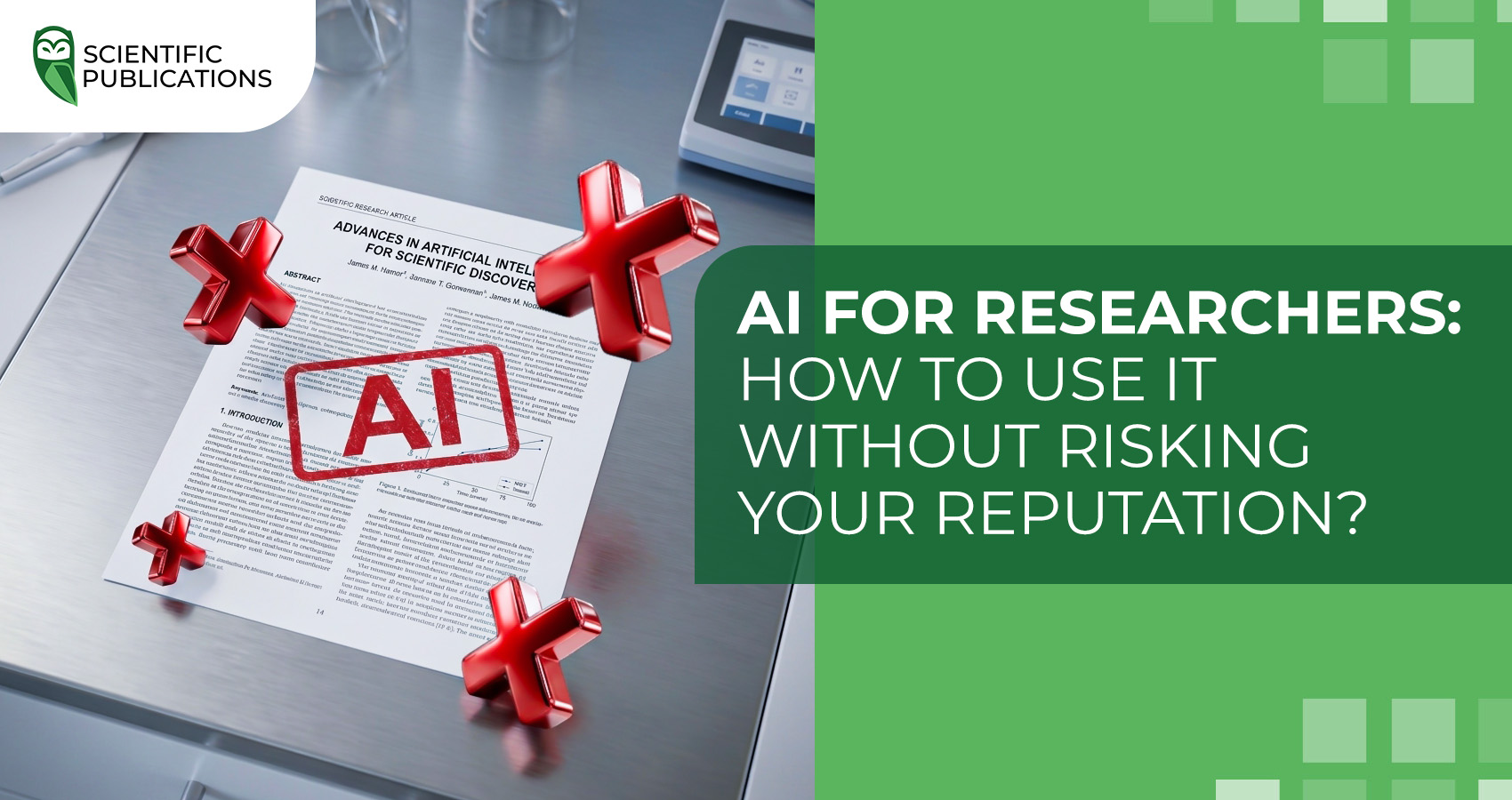
Artificial intelligence technologies offer researchers many opportunities. They make it possible to simplify work and speed up source searches, information analysis, text editing and other processes. However, the incorrect use of AI tools can lead to negative consequences. In our article, we will explain what researchers who plan to incorporate artificial intelligence into their work should pay attention to.
What benefits does AI offer researchers?
Services based on artificial intelligence help optimise a researcher’s work. In particular, they can be useful for performing the following tasks:
- Rapid search for scientific literature. Many AI platforms specialise in finding relevant sources related to the topic of a query. In this way, this process can be significantly accelerated.
- Processing large volumes of information. AI tools can be used to summarise publications, identify the main points of a paper and compare the results of different studies.
- Generating ideas. AI resources are useful at the beginning of the preparation of a scientific article, particularly when choosing the research area, topic, title, keywords and so on.
- Editing scientific texts. Artificial intelligence is useful for the initial review of a paper. In particular, it helps to identify different types of errors quickly, improve the academic style and enhance the clarity of presentation.
- Translating materials. Artificial intelligence tools can be used when working with foreign-language sources, as well as for translating text into other languages.
Despite all the benefits offered by AI, researchers should not rely on it completely. Artificial intelligence should not completely replace the author, as it is unable to take responsibility for the accuracy, integrity and originality of the work. Researchers should also check all generated information, as it may contain certain inaccuracies.
How can AI be used without risking your reputation?
When using artificial intelligence, it is important to act in accordance with the principles of academic integrity and the requirements of the chosen publication. The editorial board’s decision regarding the publication of a scientific article may depend on this. To minimise possible reputational risks, researchers should follow these rules.
Do not list AI as an author or co-author
Artificial intelligence resources cannot be co-authors of a paper because they are unable to take responsibility for its content. Authorship may be granted only to people who have made a significant contribution to the research, participated in preparing the material and agreed to take responsibility for the content of the work.
Check every fact and source
Artificial intelligence may generate non-existent references or present the content of materials incorrectly. Therefore, researchers should verify all facts, quotations, statistical data and bibliographic information against the original sources.
Do not upload confidential data
Personal data of research participants, unpublished results or information protected by confidentiality agreements should not be entered into publicly accessible AI services. If this cannot be avoided, only secure resources should be used after reviewing their rules for processing, storing and protecting information.
Do not use AI to fabricate data
To minimise reputational risks, authors should not generate non-existent research results, statistical data, quotations, sources or other materials. The entire generated text should also not be copied without critical review by the researcher.
Record how AI was used
It is important for the use of artificial intelligence tools to be transparent. Many journals may require the author to provide an explanation regarding the use of such resources. Researchers should therefore be prepared for this.
In modern science, artificial intelligence can become a useful assistant for researchers, provided that academic integrity is maintained. It is important for the final decision to remain with a human. The author must independently assess the methodology, interpret the results and formulate the conclusions of the study. This approach helps to optimise scientific work while minimising possible reputational risks.
If you have encountered difficulties with publishing a scientific article, contact the company Scientific Publications. Our specialists will support you throughout the publication process and help you take all requirements into account. To receive a free consultation, submit an application on the website, and our manager will contact you shortly. Together towards successful publications!